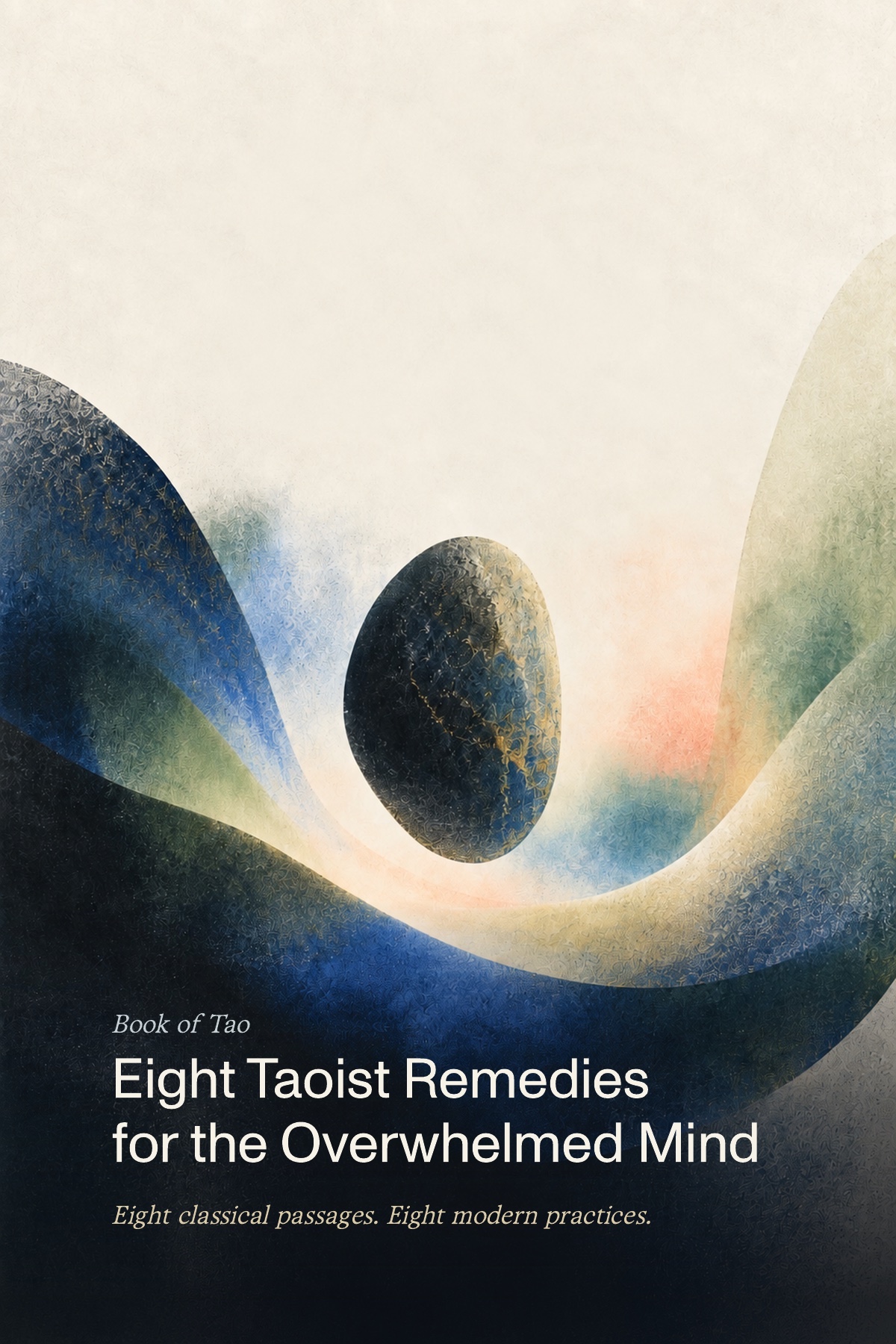
People land on this page with different questions tangled together: who actually wrote this thing, what does wu wei mean, is this the same as Buddhism. Here are honest answers to the ones that come up most, sourced to real translators and real chapters instead of the vague "ancient wisdom" gloss most quote roundups settle for.
Who Wrote the Tao Te Ching?
Tradition credits the Tao Te Ching to Laozi, a philosopher placed in the 6th century BCE and, according to legend, an older contemporary of Confucius. Modern scholars are less certain. The mix of poetic and prose styles across its 81 chapters, along with the absence of any firm external record of a single author, has led many historians to treat it as a composite text, one assembled and edited over several centuries rather than written in one sitting by one person. Estimates for when its material actually took shape range roughly from the 8th to the 3rd century BCE.
Two archaeological finds did more to pin down that timeline than any amount of textual argument. The Guodian Chu Slips, bamboo strips excavated from a tomb near Jingmen and dated to around 300 BCE, contain the earliest known fragments of the text, a partial version organized differently from what we read today. The Mawangdui Silk Texts, silk manuscripts found in a Han-dynasty tomb near Changsha and dated to around 168 BCE, preserve a fuller version close to the traditional text but with the Te Ching section placed before the Tao Ching. The book as most readers know it today, split into Tao Ching and Te Ching and carrying its current title, took its settled form sometime during the Han Dynasty (206 BCE–220 CE).
None of that uncertainty makes the text less useful. If anything, knowing it was shaped by many hands over centuries explains why it reads less like a single argument and more like a collection of related insights returning to the same handful of ideas from different angles.
What Is the Tao?
The Tao (道, "the Way") is the term Laozi uses for the underlying order that everything runs on, the pattern beneath weather, growth, decay, and human behavior alike. Chapter 1 opens by saying the Tao that can be named isn't the eternal Tao, which is the text's way of admitting up front that it's pointing at something words can only gesture toward, not pin down.
You'll sometimes see the line "Nature does not hurry, yet everything is accomplished" floating around the internet attributed to Laozi and Chapter 27. It's worth knowing that no scholarly translation of the Tao Te Ching traces that exact wording to any chapter. It's a popular quote, not a documented one, and Chapter 27 is actually about the sage's skill at using people and things well, not about nature's pace. The sentiment isn't wrong for Taoist thought generally. The chapter citation is fabricated, and it's worth being skeptical of any quote card that pairs a nice line with a suspiciously specific chapter number.
What Is Wu Wei?
Wu wei (無爲) breaks down into wu, absence or without, and wei, the kind of doing that pushes toward a fixed outcome. Put together it's usually translated as "non-action" or "effortless action," though both of those undersell it. Wu wei isn't sitting still. It's acting without forcing the result, the way water finds its way downhill without straining against the terrain.
The difference shows up plainly once you stop thinking of it as passivity. Trying to control every variable in a plan is wei. Reading the situation and moving with its actual shape, adjusting instead of muscling through, is wu wei. Chapter 2 makes the same point about the sage's whole approach to the world: acting without claiming credit, letting things develop without needing to own the outcome. For a fuller walkthrough of what that looks like when you're stuck on an actual decision, wu wei in decision-making covers the idea chapter by chapter with real examples.
What Are the Core Teachings?
Chapter 67 names what Laozi calls his three treasures directly: compassion (慈, ci), frugality (儉, jian), and not presuming to be first in the world, a form of humility. Around those three, a handful of other recurring ideas hold the text together.
- Pu (樸, "the uncarved block"): a term for simplicity, the state of a thing before it's been shaped and complicated by outside demands
- Wu wei (無爲): acting without forcing, discussed above
- Te (德): often translated as virtue or power, the quality a person or thing has when it's fully itself and acting from that nature
- Balance between yin and yang: the recurring image of opposing forces that need each other rather than one that has to defeat the other
Chapter 7 ties humility directly to effectiveness. Lin Yutang's 1955 translation renders the line as "the Sage puts himself last, and finds himself in the foremost place," which is the text's recurring argument that grasping for a position is usually what costs you it. For more on how Te specifically gets translated and misread across different editions, see what Taoist virtue actually means.
How Do I Apply These Teachings Today?
The Tao Te Ching wasn't written as a productivity manual, but its core moves (simplify, don't force, hold your position lightly) translate into ordinary decisions well. That means noticing where you're adding complexity that isn't earning its keep: too many commitments, too many open tabs, too many decisions treated as more urgent than they are.
A few concrete starting points show up across most serious readings of the text:
- Do one thing at a time instead of splitting attention across several
- Notice a reaction before acting on it, rather than responding on reflex
- Work with your actual energy levels instead of forcing a schedule that ignores them
- Hold a plan loosely enough that you can adjust it without it feeling like failure
None of that requires a meditation cushion. It's closer to a standing question you bring to ordinary moments: am I forcing this, or am I working with how it actually wants to go.
How Do I Start Reading the Tao Te Ching?
Start with one full translation before you start comparing five. Gia-Fu Feng and Jane English's 1972 translation is widely recommended for readers new to the text, partly because it reads more like poetry than philosophy lecture. Brian Browne Walker's translation takes a plainer, more direct approach that some readers find easier to sit with on a first pass. Stephen Mitchell's version is looser as a translation but has introduced more English-language readers to the text than almost any other edition.
If you want to read the whole thing for free before committing to a purchase, James Legge's 1891 translation is in the public domain and worth working through once as a baseline, even though its Victorian-era English reads differently from modern versions. For a direct comparison of how five different translators handle the same chapters, this breakdown of classical translations puts the wording side by side so you can see what changes and what stays constant. Beyond that, the Zhuangzi is the natural next text, since it works many of the same ideas through story and humor rather than aphorism.
Why Is the Tao Te Ching Still Relevant Today?
The text keeps getting read because the problem it's addressing, the urge to force outcomes instead of working with how things actually move, hasn't gone away. Chapter 49 describes the sage meeting everyone, including people who haven't earned trust yet, without a fixed judgment already in place. That's a harder practice now than it might have been in Laozi's time, given how much of daily life runs on snap sorting of people into categories.
Its advice on simplicity and restraint reads the same way. The text isn't reacting to smartphones or inboxes, obviously, but the underlying pattern it describes, more input creating less clarity rather than more, applies just as well to a crowded calendar as it did to whatever excess Laozi had in mind twenty-five centuries ago. That's less a claim about timeless wisdom and more a plain observation that some problems don't change shape much.
Is the Tao Te Ching Buddhism?
No. Taoism and Buddhism are separate traditions with different origins, Taoism rooted in Chinese philosophy going back to Laozi and the Tao Te Ching, Buddhism arriving in China from India centuries later. They influenced each other heavily once Buddhism took root in China, and folk religion in the region often blends practices from both, but the core aims differ.
Taoism, as the Tao Te Ching presents it, is about living in harmony with the Tao, the natural order already running underneath everything. Buddhism centers on recognizing suffering and working to end the cycle of rebirth through ethical conduct and insight. Taoist practice tends toward things like breath work and simplicity in daily conduct, while Buddhist practice centers more on structured meditation and doctrinal study. Both traditions shaped Chinese culture so thoroughly that separating their influence on any given later text or practice is often difficult, but the traditions themselves started from different questions and answer them differently.
Other in
Spirituality


on our social media


Never miss an update with Tao Te Ching Translations. Subscribe to our email list.
YOUR EMAIL
JOIN NEWSLETTER